
Echos of Earl
Echos of Earl
In the 18 years I spent section hiking the Appalachian Trail I kept running into “Echos of Earl”. Earl Shaffer was the first-ever AT thru-hiker, completing the trail in 1948. In 1998 he came through on his third and final thru-hike at the age of 79. Ten years later I started my section hike. I ran into several people who knew Earl or had met him on his final thru-hike.
This is the oral history I picked up following Earl’s ghost on the trail. This is mostly from memory. Bits of it are undoubtedly wrong, muddled, confused or conflated. For much more accurate and complete information I highly recommend Earl’s own book about his ’48 hike, “Walking with Spring“, and anything put out by The Earl Shaffer Foundation. Tom Johnson’s history of the Appalachian Trail is also excellent and has a lot of coverage of Shaffer, Myron Avery, etc.
These are the verbal flotsam and jetsam of a hike that I picked up decades after the fact. My entries are ordered roughly south to north based on where I picked up the info or where the encounter happened.
1. The encounters
1.1. “Chuck Norris” at Laughing Heart Hostel
In 2020 I spent several nights at the “Laughing Heart” hostel in Hot Springs, North Carolina. The caretakers at the time were “Tigger”and “Chuck Norris”. “Chuck” told me that he had been hiking (thru-hiking I think) in Shenandoah National Park and came across Earl at Dark Hollow Falls near Big Meadows. IIRC Chuck said he had a crowd around him. This might have been because his hike was getting national attention (more on that later) or just because Dark Hollow Falls is popular and not too difficult. It’s slightly off the AT.
1.2. Bob Peoples, Kincora Hostel
In 2018 I stayed at Bob People’s “Kincora” Hostel in Tennessee. Again, IIRC, 1998 was about the first year Bob and his wife were welcoming hikers. Bob related a few stories about Earl on his final “long cruise”. In one he said Earl had a loaf of Wonder Bread as part of his food. Earl sat “right there” balling up the slices to carry out: “Same nutrition, less space”. Bob said he hiked with Earl some on that trip.
1.3. Shuttle Driver, Harpers Ferry
At some point on a day hike around Harpers Ferry I ran into a woman who was waiting to pick up some hikers to shuttle them. She said she had met Earl on his last thru-hike. A few vague stories that I think I got from her were that Earl did not hike with a tent (at least on his ’48 hike). He just had an old rain slicker, and when it rained he just sat under a tree at night. She also related that he often was able to get corn meal, flower or other cooking ingredients from people in the mountain farms that were more numerous then. He made what sounded like a flat bread out of whatever he happened to have. He had a name for it, but that has slipped my mind.
1.4. AT Hall of Fame, Pine Grove Furnace
When I sectioned through Pennsylvania I stopped at the AT Hall of Fame in Pine Grove Furnace. I had ice cream, but not the full “Half Gallon Challenge” the place is famous for. Apparently after his hike Earl built several shelters for hikers. He lived in Pennsylvania (“Rocksylvania” to many) and was active in trail maintenance for years. The hall of fame had one of the shelters he had built inside on display.
1.5. ALDHA Meeting
On one of my hikes (in New Jersey?) I met a hiker named “Hobbit”. Hobbit had written and recorded a collection of his own songs about the trail (“Unicoi Gap”, etc). Apparently Earl had written poetry and music as well. Hobbit was active in ALDAH, the Appalachian Long Distance Hikers Association. He related to me that he had been at one of the “Gatherings” and the leader asked everyone who had thru-hiked to stand up by decade. As he called off the decades in reverse order fewer and fewer people stood up. When he got to the 40s, there was one. Earl.
1.6. “Honey” at “The Cabin” in Maine
In 2022 I stayed with “Honey” at “The Cabin” in Maine. Honey was amazing. In her 90s she was still hosting hikers, driving shuttle (me) and cooking up a storm. In her youth she had helped carry wood up to build Lake-of-the-Clouds hut near the top of Mt. Washington. Her ?brother-in-law? had something to do with the trail going through Mahoosuc Notch. I’m pretty sure there were Joe Dodge stories, but that’s a different legend.
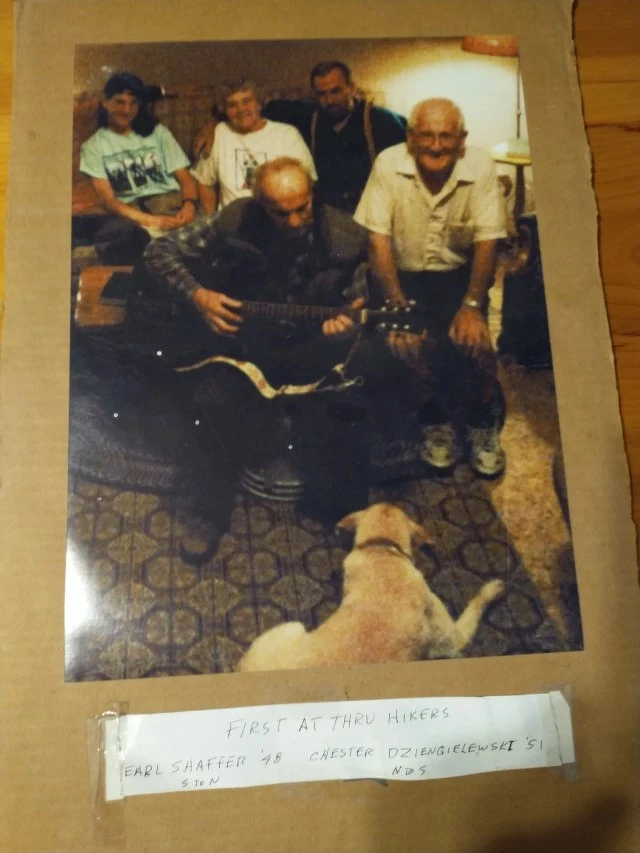
In ’98 as Earl was coming through southern Maine he based himself out of “The Cabin”. Honey and her husband “Bear” would shuttle him back each night. His hike was apparently national news. Honey told me that one day she went up into the Bigelow Range (might have the range wrong) twice in one day with a CBS camera crew looking for Earl. The picture at the top of this blog post is of Earl seated in the living room of “The Cabin” playing guitar seated next to Chester Dziengelewski,the first ever SOBO (Southbound) thru-hiker. When Earl died they bought some of his furniture at the estate sale. Some of it was in use in their downstairs hostel.
1.7. Sugarfoot, somewhere in southern Maine1
I’ve hiked with “Sugarfoot” on part of a few of his attempts to thru-hike. He tells me he ran into Earl in 98 in southern Maine. Earl was hiking by himself at the time, despite the fact that he had a hiking partner for some/most of that hike (being out there alone at 79 may not be the wisest move … Ken :-)) To hear Sugarfoot relate it, Earl did nothing but complain and was not pleasant to be around.
I’d heard from several other sources that he was not a fan of the re-routes that had taken the trail off a lot of the roads it was on in the 40s (and 60s). To be fair, in my opinion, southern Maine is the hardest stretch of the trail. It’s one thing to do it when you’re in your 20s, another to do it in your early 60s (like I did), and still something else to try at 79. I can imagine comparing the current reality to the rosy visions of your youth.
So maybe he was having a bad day or maybe the years had taken their toll as they do on us all.
2. Final thoughs
The trail is an intensely social place. Each year as a new class of would-be thru-hikers works it’s way north or south there is a grapevine fueled by word of mouth, log book entries at the shelters, in hostels and more recently texting, various apps and web sites and the like. Each year as a new class of hikers starts, the old stories are mostly gone and new stories are being made. I found it interesting that 10 to 28 years on I was still able to pick up oral tradition from a man who first traversed the trail in 1948. It’s the stories that connect us. It’s the stories we share. Earl’s story was foundational for the AT and his memory lives on.

Footnotes:
Sugarfoot informs me "I was southbounding Vermont and was nearly out of that ravine when Earl in pith helmet started down. I greeted him and we sat down on facing rocks about three feet apart. It started to rain lightly. I asked if he was going to put anything on. He answered, “Na, that’s for sissies.”… It started to rain harder, a real frog drowner. We couldn’t see each other and still he sat. Eventually he broke it off. I finished with the rocks and put on my rain suit … His biggest complaints were the rerouting of the trail away from towns and that no one wanted to hike with him."
For context, the hill in question was the last two miles downhill (NOBO) to Route 9 by Bennington, VT. I (George) hiked that last year. It's nasty at the bottom. Rocks. Even with poles and no rain I was worried about breaking a leg for the last mile or so. Earl was about to come down that. In the rain. Without poles. At 79. Yikes !!!