Why do we use windows?
JTR’s blog post “How I Organize My Screen(s)” caused me to ask more fundamental questions: why do we have/use windows?
Lately, I’ve found myself more and more just having a single Emacs instance in full screen mode. If I’ve left a bunch of windows open in the last session, the first thing I do is close them all to get a clean start. Same thing with browser tabs/windows (if I don’t just close the browser). It’s like starting with a clean desk/a clean slate.
I think Ken Thompson wrote most of Unix using line editors (/bin/ed?) on printing terminals. I caught the tail end of that world in high school before we had any video terminals. Sure, you might, lacking windows, have print-outs of your code, maybe marked up by hand, or even your paper FORTRAN coding sheets. If you typed ‘-10,+10p’ in /bin/ed (or it’s equivalent PRINT statements in the basic BASIC interpreter we used), you got a 20 line window of the code you were working on printed on the scroll of paper on your TTY (yes, a real Teletype).
Having printouts of your code worked as memory extenders. I think having multiple visible windows in Emacs serves the same function. When all you had was a line editor, you had to basically remember all your code.
JTR’s post mentions having chat apps, web browsers, editors, email apps and games open. These essentially allow you to have different foci, to “multitask”, to allow certain people/things to interrupt your focus. Those are choices.
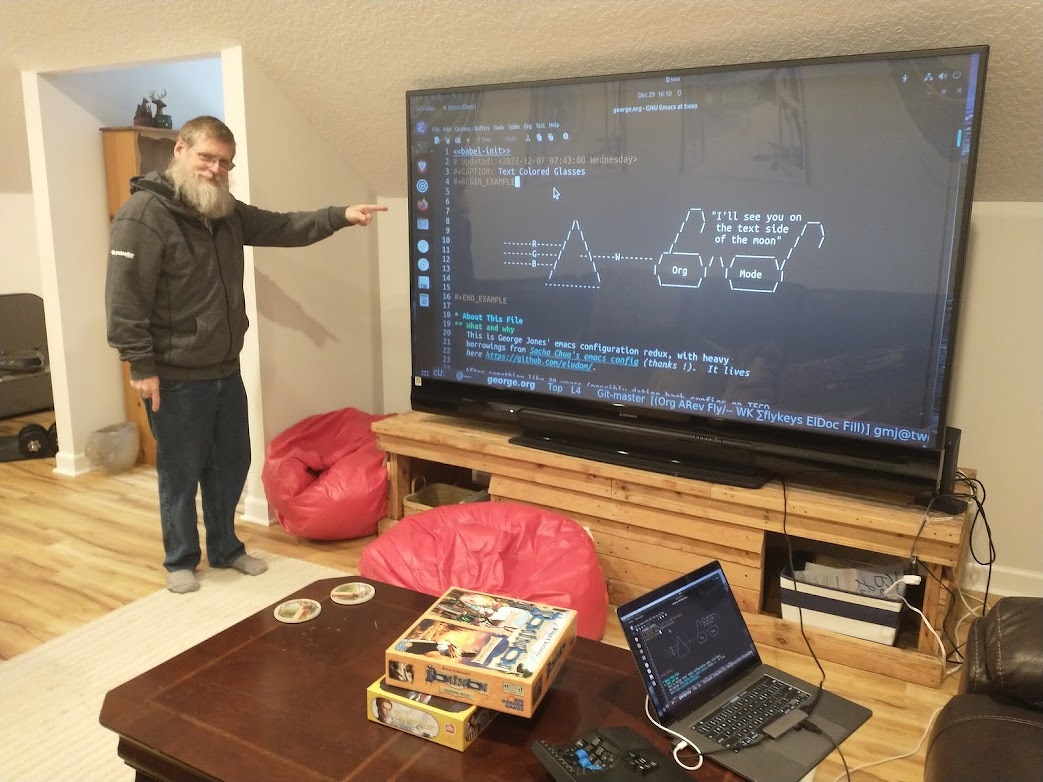
One time, when staying at an Airbnb, presented with the largest TV screen I’d ever seen, I could not resist the urge to plug in the DVI cable and bring up the world’s biggest Emacs window. Some people watch football games, me…
Last night I used Linux on a 10-year-old laptop to play a DVD. I made the video I was watching full-screen on the external monitor. Again, focus.
When writing this, I did pull up a copy of JTR’s post on the laptop screen for reference as I was writing it, but once I was done with it, having something else up annoyed me, so I closed it. The only thing up now is this one Emacs windows. People are different. I need focus.
So, why windows? 1. Because the technology enabled it? (it gave us Emacs as one side-effect.) 2. Because they extend our memory? 3. Because they enable us to choose which apps/people are able to interrupt us? Am I missing something?